How to Use an AED: Step-by-Step Guide
When someone's heart stops beating in a shockable rhythm, every minute without defibrillation reduces survival by approximately 7 to 10 percent. Automated external defibrillators — AEDs — exist to close that gap. They are designed specifically for ordinary people with no medical background to use safely and effectively during the most stressful moments of their lives.
If the idea of using a defibrillator intimidates you, you are not alone. Movies and television dramatize defibrillation with paddles, shouting, and chaos. Real AEDs are nothing like that. They are calm, methodical devices that talk you through every step. You cannot accidentally shock someone who does not need it. The machine decides. Your job is to follow its voice prompts and keep CPR going.
What an AED Actually Does
An AED is a portable electronic device that analyzes the heart's electrical rhythm and, when appropriate, delivers a controlled electric shock to restore a normal heartbeat. The most common shockable rhythms during cardiac arrest are ventricular fibrillation (VF) and pulseless ventricular tachycardia (VT). In both cases, the heart is quivering ineffectively rather than pumping blood.
The shock essentially resets the heart's electrical system, giving it a chance to restart in a normal rhythm. AEDs do not restart hearts that have stopped due to non-shockable causes like asystole (flatline). In those cases, the device will advise you to continue CPR — which is still life-saving because compressions keep blood circulating.
Modern AEDs are remarkably safe. They will not deliver a shock unless the internal computer detects a shockable rhythm. You cannot harm someone by attaching pads and turning on the device. The greatest risk is not using the AED at all.
Where to Find AEDs
AEDs are more common than most people realize. Look for them in:
- Offices, warehouses, and manufacturing facilities
- Gyms, recreation centres, and sports arenas
- Schools, universities, and libraries
- Airports, train stations, and shopping malls
- Hotels, restaurants, and community centres
- Places of worship and government buildings
They are typically stored in wall-mounted cabinets marked with a heart-and-lightning-bolt symbol, often bright red or green. Many smartphone apps and municipal websites maintain AED location registries. If you manage a workplace or public space, knowing exactly where your nearest AED is located — and ensuring your team knows too — should be part of your emergency preparedness plan.
Step-by-Step: Using an AED During Cardiac Arrest
Before reaching for the AED, confirm the person is unresponsive and not breathing normally. Call 911 (or direct someone to call) and begin CPR immediately. Send another person to retrieve the AED while you compress. If you are alone, start CPR first, then retrieve the AED yourself as soon as possible.
Step 1: Power On the AED
Open the AED case and press the power button. Some models power on automatically when you open the lid. The device will immediately begin giving verbal instructions — listen carefully and follow each prompt. Most AEDs also display visual diagrams on a screen showing exactly what to do next.
Step 2: Expose the Chest and Attach Pads
The person's chest must be bare for the pads to adhere properly and conduct electricity effectively. Remove or cut through clothing if necessary. If the chest is wet, quickly dry it with a towel or clothing. Excessive chest hair may prevent pad contact — many AED kits include a razor for this purpose.
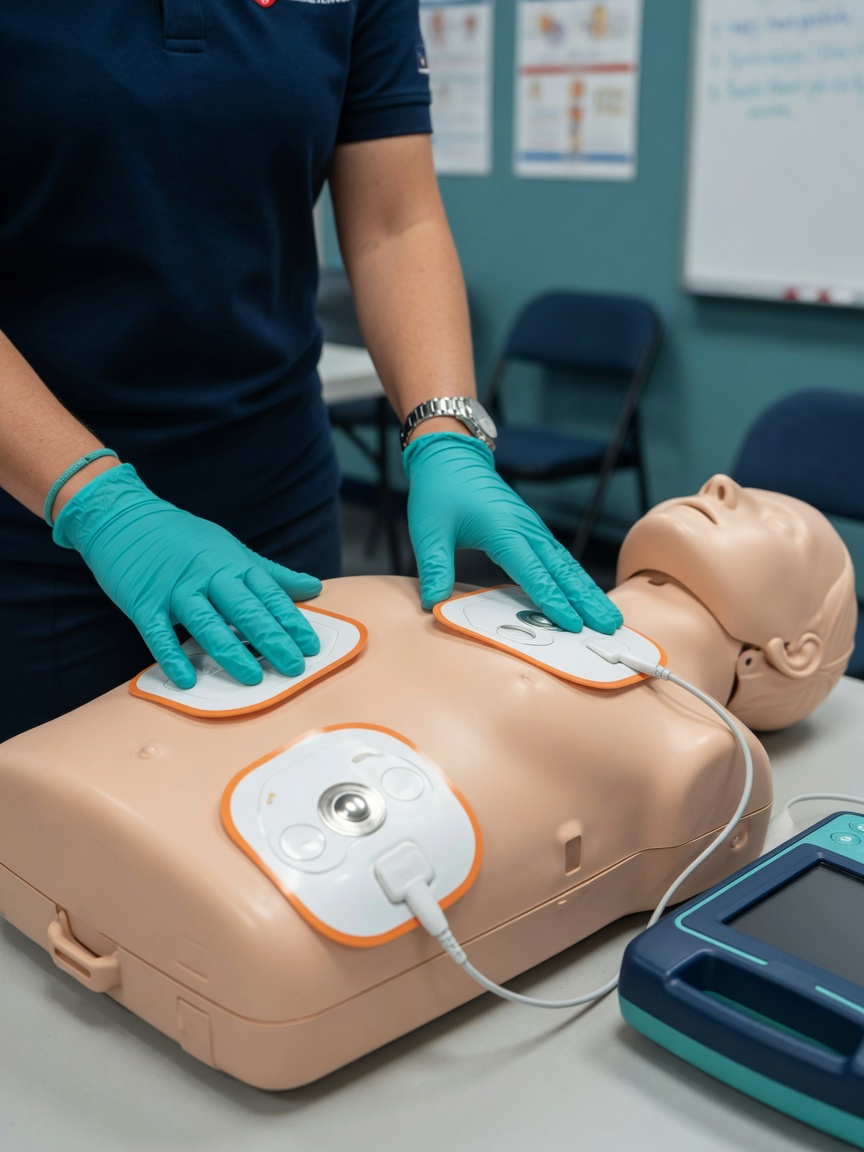
Peel the backing off each pad and place them according to the diagrams printed on the pads themselves:
- Adult pad placement: Place one pad on the upper right side of the chest, just below the collarbone. Place the second pad on the left side of the chest, below the armpit along the ribcage.
- Alternative placement: Some protocols allow front-and-back placement (one pad on the centre of the chest, one on the back between the shoulder blades) if standard placement is not possible due to injuries, pacemakers, or other factors.
Press each pad firmly to ensure full contact with the skin. Plug the pad cable into the AED if it is not already connected. The device will announce that it is analyzing the heart rhythm.
Step 3: Stand Clear
When the AED announces "Stand clear" or "Analyzing," stop CPR immediately and ensure nobody is touching the person. The device needs a motion-free window to read the heart's electrical activity accurately. Announce loudly: "Stand clear! Everyone stand clear!" Look visually to confirm no one is in contact with the victim.
This step is critical for two reasons. First, movement interferes with rhythm analysis. Second, if a shock is delivered while someone is touching the patient, that person could receive an accidental shock.
Step 4: Shock Delivery (If Advised)
After analysis, the AED will either advise a shock or advise CPR. If a shock is recommended, the device will say something like "Shock advised. Charging. Stand clear." Continue to ensure nobody touches the patient.
Once charged, the AED will prompt you to press the flashing shock button. Use the heel of your hand and press firmly — you cannot shock yourself through the button. After delivering the shock, the device will immediately instruct you to resume CPR.
If the AED says "No shock advised," do not be discouraged. This means the heart rhythm is not shockable at that moment. Begin or resume CPR immediately. The AED will re-analyze every two minutes and may advise a shock later if the rhythm changes.
Step 5: Resume CPR Immediately After the Shock
This is where many bystanders make a critical error — they stop to watch and wait after delivering a shock. Do not wait for the AED to tell you to start compressions. The moment the shock is delivered (or if no shock is advised), begin CPR right away with 30 compressions followed by 2 breaths, or continuous compressions if you are performing hands-only CPR.
Continue CPR for two minutes until the AED prompts you to stop and re-analyze. The cycle repeats: analyze, shock if advised, CPR, analyze again. Keep going until EMS arrives and takes over, the person shows obvious signs of life, or you are too exhausted to continue.
Pediatric Pads and Child Settings
Cardiac arrest in children is less common than in adults, but when it happens, rapid defibrillation is equally important. Many AEDs come with pediatric pads or a pediatric energy reducer.
When to Use Pediatric Settings
Use pediatric pads or the child/infant setting for victims younger than 8 years old or weighing less than 55 pounds (25 kilograms). Pediatric pads deliver a lower-energy shock appropriate for a child's smaller body.
Pediatric Pad Placement
For infants and small children, place one pad on the centre of the chest and one on the centre of the back. This front-and-back placement is standard for pediatric victims because their chest is too small for the adult side-by-side configuration. Ensure the pads do not touch or overlap.
If Pediatric Pads Are Not Available
If no pediatric pads are available and the AED has no child setting, use adult pads on a child. For infants, place one adult pad on the chest and one on the back, ensuring the pads do not touch. Never withhold defibrillation from a child because pediatric pads are unavailable — an adult shock is far better than no shock at all.
Special Situations and Safety Notes
- Pacemakers and implanted devices: Place pads at least one inch away from visible implants or surgical scars. Do not place a pad directly over a pacemaker bulge.
- Medication patches: Remove transdermal patches (such as nitroglycerin) from the chest before applying AED pads, using gloves if available.
- Water and metal: Do not use an AED on someone lying in standing water. Move them to a dry surface first. Avoid placing pads over metal jewellery or piercings on the chest.
- Pregnancy: Use the AED normally on a pregnant person in cardiac arrest. Saving the mother's life is the priority.
Practice Builds Confidence
Reading instructions is valuable, but the first time you hear an AED say "Shock advised" should not be during a real emergency. Hands-on practice with a training AED — one that simulates scenarios without delivering real shocks — builds the calm, automatic response you need when adrenaline is flooding your system.
AEDs save lives, but only when someone is willing to grab one and use it. The device does the hard work of rhythm analysis and energy calculation. Your job is simpler than you think: turn it on, stick on the pads, stand clear, push the button if told, and never stop compressions.