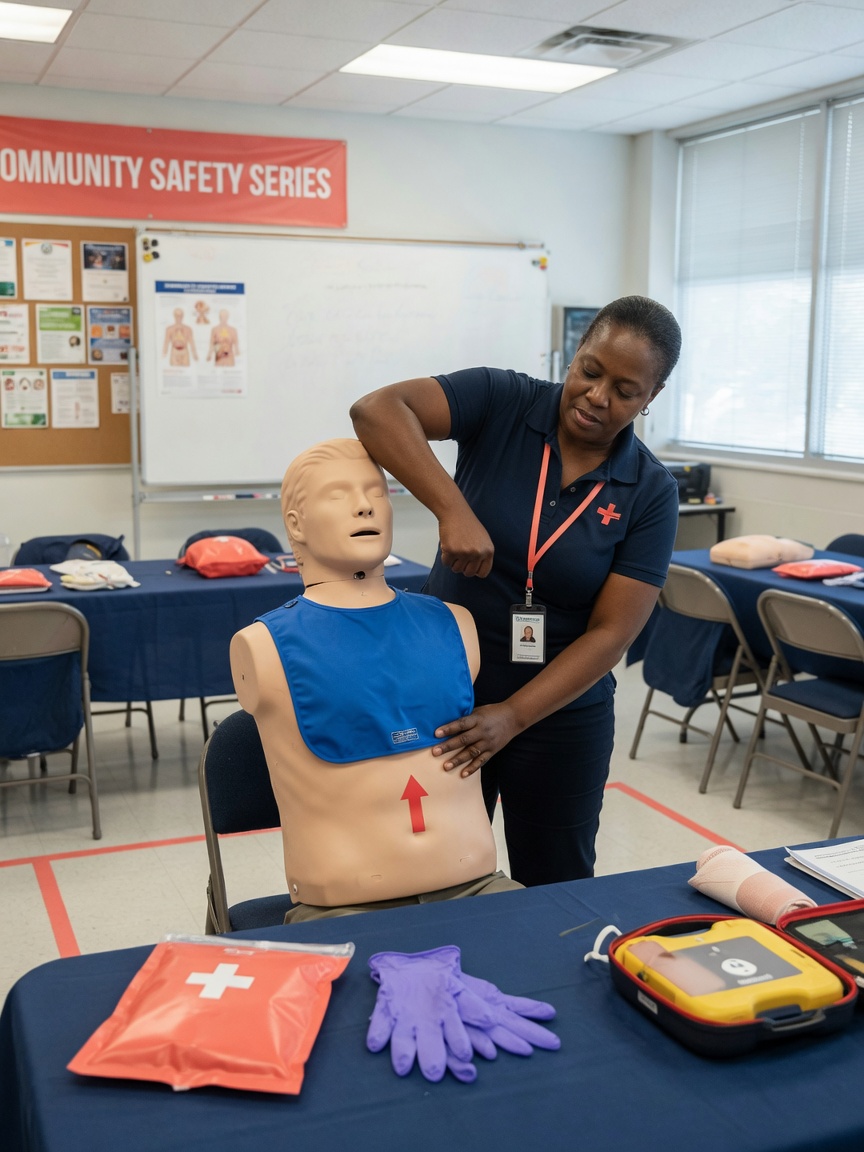
Choking Emergency: What to Do in 60 Seconds
A choking emergency unfolds in seconds. One moment someone is eating, laughing, or playing with small objects. The next, their airway is blocked and they cannot get enough oxygen to the brain. Brain damage from complete airway obstruction can begin within four minutes. You may have less than 60 seconds to recognize the problem and take the right action.
Choking is one of the most common preventable causes of accidental death, particularly among children under three and adults over 65. The good news is that the techniques to clear a blocked airway are straightforward, require no equipment, and can be performed by anyone who knows what to look for and how to respond.
Mild Choking vs. Severe Choking
Not every coughing fit is a choking emergency. The key distinction is whether the airway is partially blocked (mild) or fully blocked (severe). Your response depends entirely on which situation you are facing.
Mild Choking (Partial Airway Obstruction)
In a mild choking event, the person can still breathe, cough, speak, or cry. Their body is trying to force the object out on its own, and that coughing is the most effective tool available. Signs of mild choking include:
- Forceful, effective coughing
- Ability to speak or make sounds
- Some air movement — you may hear wheezing between coughs
- Clutching the throat but still responsive and alert
What to do: Encourage the person to keep coughing. Do not hit them on the back while they are coughing forcefully — this can push the object deeper. Stay with them, monitor closely, and be ready to escalate if coughing becomes ineffective. Call 911 if the obstruction does not clear within a few minutes or if the person's condition worsens.
Severe Choking (Complete Airway Obstruction)
Severe choking means the airway is fully blocked. The person cannot cough effectively, speak, breathe, or make sounds. This is a life-threatening emergency requiring immediate intervention. Signs include:
- Silent or weak, ineffective coughing
- Inability to speak or cry
- Clutching the throat with both hands (the universal distress sign)
- Panicked, wide-eyed expression
- Cyanosis — bluish colour around the lips and fingernails
- Loss of consciousness as oxygen runs out
What to do: Act immediately. Do not wait for the person to recover on their own. Begin the appropriate choking response technique for their age group, described below.
Universal Distress Sign: The Silent Clutch
The universal sign for choking is both hands clutching the throat. If you see someone make this gesture — especially if they cannot speak when you ask "Are you choking?" — assume a severe obstruction and begin treatment immediately. Do not waste time asking multiple questions. A person who can answer you is not choking severely.
Ask once: "Are you choking? Can you speak?" If they cannot respond verbally, or can only nod weakly while unable to cough, begin abdominal thrusts (for adults and children) or back blows and chest thrusts (for infants) without delay.
Abdominal Thrusts for Adults and Children
Abdominal thrusts — commonly known as the Heimlich manoeuvre — are the primary technique for relieving severe choking in responsive adults and children over one year of age. The goal is to create an artificial cough by forcing air from the lungs upward to dislodge the object.
How to Perform Abdominal Thrusts
- Stand behind the person and wrap your arms around their waist.
- Make a fist with one hand and place the thumb side against the upper abdomen, above the navel and well below the breastbone.
- Grasp your fist with your other hand.
- Give quick, inward and upward thrusts, as if trying to lift the person off the ground.
- Repeat thrusts until the object is expelled, the person can breathe or cough, or they become unresponsive.
Each thrust should be distinct and forceful. Continue without pausing between thrusts. If the person is significantly larger than you, you can use the same technique with them sitting in a chair, or perform chest thrusts instead if you cannot reach around their abdomen effectively.
Pregnant or Obese Persons
For pregnant women and people who are obese, use chest thrusts instead of abdominal thrusts. Place your hands on the centre of the chest, similar to CPR hand position, and pull straight back with quick thrusts. The motion is inward rather than upward.
Back Blows and Chest Thrusts for Infants
Infants under one year of age have delicate internal organs and small airways. Abdominal thrusts are not recommended for babies because they can cause serious injury. Instead, use a combination of back blows and chest thrusts.
Back Blows
- Support the infant face-down along your forearm, with their head lower than their chest.
- Rest your forearm on your thigh for stability.
- Support the infant's jaw with your hand — do not compress the throat.
- Deliver five firm back blows between the infant's shoulder blades with the heel of your other hand.
Chest Thrusts
- Turn the infant face-up while keeping their head lower than their body.
- Place two fingers on the centre of the chest, just below the nipple line.
- Deliver five quick chest thrusts, compressing about 1.5 inches (4 centimetres).
- Alternate five back blows and five chest thrusts until the object is expelled or the infant becomes unresponsive.
Always support the infant's head and neck throughout the process. Never shake a baby. The combination of gravity and targeted pressure is what dislodges the obstruction.
When to Start CPR
If the choking person becomes unresponsive, lower them carefully to the ground and call 911 immediately (or activate emergency services if not already done). Begin CPR starting with chest compressions — do not check the mouth first.
After every 30 compressions, before giving rescue breaths, open the mouth and look for the object. If you see it, sweep it out with your finger. Only remove objects you can see — blind finger sweeps can push obstructions deeper. Give two rescue breaths and continue the cycle.
CPR for a choking victim who has gone unresponsive follows the same 30:2 ratio as standard CPR, with the added step of checking the airway before each set of breaths. If an AED is available, use it as you would in any cardiac arrest. Continue until EMS arrives, the object is removed and the person breathes normally, or you are physically unable to continue.
Prevention: Reducing Choking Risk
The best choking response is preventing the emergency in the first place. Consider these evidence-based prevention strategies:
- Cut food properly — Cut round foods like grapes, cherry tomatoes, and hot dogs lengthwise into quarters for young children. Avoid whole nuts, popcorn, and hard candies for children under four.
- Eat mindfully — Encourage sitting while eating, chewing thoroughly, and avoiding talking or laughing with a full mouth. This applies to adults as much as children.
- Childproof small objects — Coins, button batteries, small toy parts, and balloon pieces are common choking hazards. Keep them out of reach of infants and toddlers.
- Supervise mealtime — Children should not eat while running, playing, or riding in a car. An adult should be present during meals and snack time.
- Learn the techniques — Caregivers, parents, teachers, and grandparents should all know how to respond to choking. Seconds matter, and the person choking may not be able to help themselves.
- Modify food for seniors — Older adults with swallowing difficulties (dysphagia) may need softer foods, smaller bites, and thickened liquids. Consult a healthcare provider if choking during meals becomes recurrent.
Act Decisively
Choking emergencies reward speed and decisiveness. Hesitation — wondering if you should help, worrying about hurting the person, or waiting to see if they recover — costs precious seconds. If someone cannot breathe, cannot speak, and is clutching their throat, you have your answer. Begin the technique, call for help, and do not stop until the airway is clear or professional rescuers take over.